Have a look at Bill Gates Raves about the Mac (1984)
Too bad Apple was too stupid to capitalize on its superiority in those days – then we could all be bitching about them instead of Microsoft now!
Have a look at Bill Gates Raves about the Mac (1984)
Too bad Apple was too stupid to capitalize on its superiority in those days – then we could all be bitching about them instead of Microsoft now!
I read Eight compelling reasons why you should not even think of using Office 2007, and I think I would like to respond to these “eight compelling reasons”.
Just my thoughts. Cheers
In response to the post Microsoft’s Open Source Software is Junk? and the article which triggered it, I would like to offer a few comments:
This article has some good thoughts about the weaknesses of OOXML. I am not sure I agree with all of the author’s conclusions, but it is definitely worth reading if you are interested in the OOXML standardization debate.
http://www.arstdesign.com/articles/OOXML-is-defective-by-design.html
The post Microsoft Unveils New Linux Hate Site, refers to Microsoft’s replacement for their “Get the Facts” site as a “Linux Hate Site”. I saw the same comment on Digg a couple of days ago.
What are these people smoking? Where on that site is there anything “hateful” about Linux. Microsoft is a commercial software organization. They sell operating system software, including some for servers. They consider Linux to be competition. Hence, they have content which compares their products to their competition (Linux, mainframes, etc.). In typical marketing fashion, their site shows that their products are better than the competition. It would be sort of stupid to do otherwise.
How is this different than the marketing efforts of pretty much every other commercial organization in the world?
I also noticed a rant in a comment on Digg about how badly designed the page was, because the person making the comment could not find the so-called “comparison”. I think the tabs along the top point to the comparison pretty clearly, as does the big piece of white text on bright orange background that says “Find out how Windows Server compares to Linux ->”.
The point I am trying to make here is that the Linux community damages its own cause by making meaningless, fact-deprived statements. Stop ranting about MS and do something useful.
There is nothing particularly new in this article Forget about the WGA! 20+ Windows Vista Features and Services Harvest User Data for Microsoft – From your machine! – Softpedia, but it was referenced on a blog post I came read this evening. I few thoughts came to mind:
I found this post by Mark Shuttleworth interesting and well written (I found it after reading a ZDNet article referencing it – I will not link to it, since the ZDNet blogs do not seem to handle trackbacks) Emerging consensus in favour of a unified document format standard?
I agree with a number of things in this post.
Is Microsoft investing heavily in getting OOXML accepted? I would be pretty sure they are – I would be.
I agree there are technical issues with the current OOXML spec, based upon what I have read elsewhere. I do not believe that these issues are a reason to abandon the spec, only that “fast-tracking” the spec without fixing them is wrong. The OOXML spec should go through as much review as is necessary to satisfy the standards bodies that it is ready.
I agree that ODF supporters (and other OOXML opponents) should make their opinions known in a technically meaning full way to their representatives on the standards bodies.
I also believe that supporters of OOXML should do the same.
I still disagree with the belief that there must be one “standard”. It still seems strangely ironic to me that the open source community is very much in favour of having alternatives, as long as the alternatives do not come from Microsoft.
Over the last few months (or the last year or more), it has become extremely fashionable to beat up on Vista. Heck, it is a great way to generate hits on you site or blog, maybe get Dugg, whether you have anything useful to say or not. I am talking about posts like this, or this, or this whole blog.
Personally, I run Vista on several machines, and have few problems which were not related to the failure of third parties to provide updated drivers, or updated versions of software for Vista (sometimes makes me wonder if there has been a conspiracy on the part of other vendors to purposely sabotage Vista – but it is more likely just not bothering to provide what customers pay for). I also still run XP on a couple of boxes, and Win2K3. On my main development box, I also run a number of operating systems in VMWare, including WinXP, Win 2K3, Fedora, Ubuntu, and several “minimalist” Linux distros for playing around with.
An unfortunate fact of life is that all operating systems available right now suck, at least in some aspect or another. Linux suffers from many driver limitations (though this is getting better), and a wannabe user interface that spends far too much time trying to look like Windows, while missing the point of usability altogether. Windows (all versions) suffer from security issues, and from performance and stability issues inherent in trying to be all things to all people. I will not comment on Mac OSX, because I have not run it. It is also kind of irrelevant, since I cannot run it unless I buy Apple’s hardware.
Vista has its own usability issues. Some that are pointed out are valid. The UAC implementation is moronic. The UI path you have to follow to connect to a wireless network is annoying. Here is one I discovered today – disk defragmentation. When you defragment you hard drive you get this useful dialog:
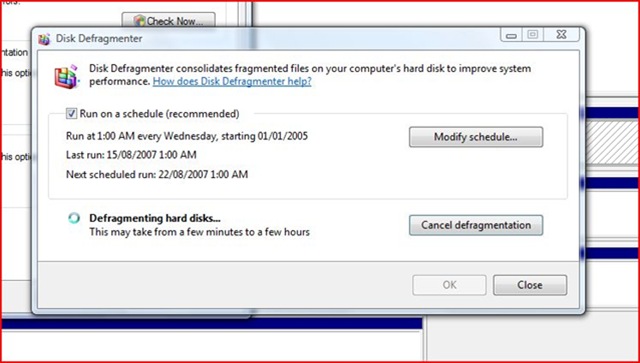
Isn’t that helpful? No progress indication. No estimated time to completion. Just a statement that it could take anywhere from a few minutes to a few hours. Gee, thanks.
The problem is, this kind of thing is not just a problem in Vista, or Windows in general. It is pervasive in all operating systems, and almost all software written to run on them. Most software is filled with minor little usability gaps like this.
So stop beating up on Vista (unless you need the traffic), and start thinking about how to make the whole situation better.
VentureBeat » Google continues its assault on Microsoft, offering StarOffice suite
Two thoughts spring to mind:
This is a nice post about the Snipping Tool in Vista. I really, really liked the design of the snipping tool that was pat of the Tablet PC Experience Pack on Windows XP. Unfortunately, I cannot show a picture, because I am not running Windows XP anywhere, but the UI while in snipping mode was very nice, with a semi-circular menu docked to the bottom of the sceen with you snipping options.
Oh well – nice post anyway.


 FredSpace
You must be logged in to post a comment.