Linus: "Microsoft Hatred Is a Disease"
This is a great quote from Linus.
I have been arguing this for a long time – and also that the vitriolic rhetoric from obsessive MS haters hurts the the open source movement far more than Microsoft ever could.
Linus: "Microsoft Hatred Is a Disease"
This is a great quote from Linus.
I have been arguing this for a long time – and also that the vitriolic rhetoric from obsessive MS haters hurts the the open source movement far more than Microsoft ever could.
De-orbiting the ISS in 2016? | Bad Astronomy | Discover Magazine
This is a perfect example of what I was saying in my post yesterday. Given that any space program is going to be a large scale, multi-year (possibly multi-decade) effort, how do you accomplish anything when it is tied to the constant budgetary and political bullshit that infects our governments? Without the ability to define programs which are immune to political tides, it is virtually impossible, and the ISS is prime example.
As long as we have few if any leaders in the world who have any vision beyond the next election and their own (very well financed) retirements, there is no hope for space exploration.
The only hope lies in non-governmental space exploration.
Michael Vick should be banned for life from NFL – George Dohrmann – SI.com
I have a lot of issues with the NFL’s attitude towards players who commit crimes or other actions of which the NFL disapproves.
I agree that what Vick did was horrendous. It is unthinkable to me that any human being could torture and kill animals for recreation (though for some reason shooting animals for entertainment is still acceptable).
That being said, the United States has a legal system. Michael Vick has been judge and punished for his actions by that legal system. If we disagree with the severity (or lack there of) of his punishment, then the issue is with the legal system. Vick has been sentenced. He is serving the terms of his sentence.
What right, then, does the NFL have to impose further punishment on him? Why does the NFL have the right to do what other employers can not?
Say I am a developer, a consultant, or a journalist, and I commit some crime not related to my profession – say DUI, drug possession, jay walking, animal cruelty, whatever – and I am held accountable by the legal system. My actions do not affect my ability to do my job. Would it then be appropriate for my employer to impose a suspension on me? To levy an additional fine? To tell me I am no longer allowed to work in my field?
Then why does the NFL have the right to impose its will, it opinion above and beyond the legal system?
I have been sitting and thinking about this day in history – obviously, the 40th anniversary of the Apollo 11 moon landing.
Like many others, I grew up watching the Apollo program. Honestly, it was a major aspect of my childhood. I remember being up in the middle of the night in 1969 (at 7 years old) to watch Neil Armstrong descend to the moon’s surface. I remember sitting glued to the TV to watch every second of coverage, not just of Apollo 11, but of all of the missions which followed. I remember setting up my little cassette recorder in front of the TV speaker to record the audio so I could listen to it over and over (my first act of copyright infringement).
It was really a magical time for me – I was a little kid, and all of this real-life adventure was going on. I was already interested in astronomy at that age – I had started carrying astronomy books around with me when I was about 4. These events influenced much of my life – leading to my obsessions with astronomy and physics. It also led to my early career choices – working in remote sensing, and later working in satellite flight dynamics (sometimes I wonder why I ever stopped doing that).
It seemed at that time like we had just embarked on the first steps of a grand adventure, and that the adventure would only get grander.
So what the heck happened? Apollo rapidly lost it magic for the world. Skylab was interesting, but was ultimately a dead end. The shuttle as a program seemed exciting, but has never seemed to escape its problems. And there has never seemed to be a grand, long-term, sustainable vision for manned space flight.
Looking back, as impressive as Apollo was, mankind went to the moon for the wrong reasons. In the sixties, there was no clear, long-term reason for going to the moon, at least not at the public and governmental levels. It was all about “we have to beat the communists to the moon”. It was not about “we need to go to the moon as a first step of humankind’s push to explore, to learn and expand.”
That is why interest in Apollo died. Once the Russians had been beaten to the moon, the race was over and there was no longer any reason to keep going back. The Soviet Union seemed unlikely to catch up or leap frog the US at the time, so there was no real motivation to go further.
Then came the Space Station. A grand vision. A permanent home in orbit. A platform not just for scientific study, but as a platform to reach further. Unfortunately, the Space Station as it came to be is a pale shadow of that vision.
This highlights the problems with the space program still. The percentage of the population that really, strongly believes in manned space travel is small. Every so often, someone will stand up with a grand vision. Occasionally, it will get funded (but never properly, just enough for promotional purposes). Then comes the next budget crunch, economic downturn, or election, the the vision gets revised, the scope reduced, and the budget whittled away.
We are seeing this right now. George W. Bush had his grand vision for going to Mars (trying to be like JFK?). Even at the outset however, it was not funded properly (cannot take away from the budget for blowing the hell out of everyone who disagrees with you). And this summer I see that a round of reviews are underway to assess (i.e. reduce) the scope.
So how do we actually have a space program? How do we push forward?
Well, the best way (maybe the only way) is for private sector to see a profit in exploration. Nothing gets people moving like dollar signs and ROI. Unfortunately, the ROI of space exploration is long term, and the vast majority of our political and business leaders are unable to think beyond the current quarter, current year, or the next election.
If space exploration remains in the hands of government, a way must be found to fund it, in a way that protects it from political games played by small minded people.
Unfortunately, I see very little hope for any of this. The magic has died – or maybe it was really all just an illusion to begin with.
The past week has seen quite a bit of new information being published by Microsoft regarding Office 2010 and SharePoint 2010. This is just the start, I am sure, and by the time Office 2010 is released next year, we will probably all be getting sick of hearing about it (jk). A good place to start getting a feel for SharePoint 2010 is to look at SharePoint 2010 Sneak Peek videos recently posted by Microsoft.
I had a look late last week at the new features from a general perspective – see my column over at Legal IT Professionals. In this post I want to have a look at some of the new features for developers. I will give my take on what I saw in the videos, and also mention a few things that I was hoping to see but didn’t.
The Developer Sneak Peek Video covers a number of features of SharePoint 201 for developers:
The Visual Studio SharePoint tools are intended to improve programmer productivity when developing for SharePoint. A major new feature is the Visual Web Part Designer. As the name implies, this tool lets you visually design your web part UI, rather than coding it or using something like SmartPart. While the demonstration in the video is extremely simple, this tool should greatly improve the process of developing Web Parts for SharePoint 2010.
The support for Feature and Solution packaging seems to be greatly improved as well, and actually looks like it is a real Visual Studio tool rather than an afterthought.
Microsoft has also added a SharePoint node to the Server Explorer in Visual Studio. This allows you to look at the structure and content of the SharePoint site you are targeting without having to bounce back and forth between IE and Visual Studio.
Another big feature is the Business Connectivity Services design tools for Visual Studio. This is a set of tools for implementing BCS entities from within Visual Studio, allowing a developer to do more sophisticated BCS development than is possible from SharePoint Designer.
Moving beyond Visual Studio, there are a number of other important enhancements for developers.
One of these enhancements is the Developer Dashboard. This is a component which is enabled by a sight administrator, and can be added to any SharePoint page to support development and debugging. It provides diagnostic information regarding including the detailed page request, timing information, information on Stored procedures called, as well as details regarding resource usage, authenticated user, web part timings, etc. This should be a big help in troubleshooting issues.
Another addition is the addition of the Client Object Model, a client-side API for interacting with data on the SharePoint server using JavaScript, .NET code, or Silverlight.
Speaking of Silverlight, there is now a built-in Silverlight Web Part to facilitate deployment of rich UI components. The video shows a nice demonstration using Silverlight, the Silverlight Web Part, and the Client Object Model.
While I definitely like what I see for developers in SharePoint 2010, there are a number of things I want to see but didn’t:
Well, those are my first thoughts on SharePoint 2010 for developers. I can’t wait to see/learn more over the coming months.
This is very cool – NASA’s Lunar Reconnaissance Orbiter has taken images showing the portions of the LEM left behind by the Apollo missions…
NASA – LRO Sees Apollo Landing Sites
Of course, the conspiracy theorists will argue that this is fabricated as well!
Yeah I know, it launched a couple of weeks ago – I’ve been busy. From the Crowd Space web site:
“Crowd Space is a tool for managing groups such as your church, hobby club, community group, team, school association, or guild.”
Check it out at http://crowdspace.net/
Also note, Crowd Space is hosting free BBQ on Monday, July 20, 2009 in Moncton to celebrate the launch.
Apple plays softball with Palm – Fortune Brainstorm Tech
Once again, Apple demonstrates that it is the most proprietary, closed organization in the consumer marketplace. Again, is MS pulled something like this, there would be lawsuits and a DoJ investigation.
I have had a problem ofver the last few weeks with IE8 (running on the Windows 7 RC). Suddenly, any time I opened a new tab or new window (including initial startup, opening a blank tab, or openig a link in a new tab or window) became extremely slow. I am talking 10-30 seconds just to open a blank tab. It would sit there saying “Connecting”. What the heck is a blank tab connecting to for 30 seconds????
Finally, this morning, I got irritated enough to look for a solution.
After a little digging on the web, I found several references to similar problems which seemed to be related to particular browser add-ons. Unfortunately, I do not have any of the add-ons from any of the discussions I found. It did seem to indicate an add-on could be the problem, however. So, I decided to just work through it the hard way – by trial and error. I opened the IE8 add-on manager (Tools | Manage Add-ons) and disabled all of the add-ons listed. I closed the dialog and created a new tab – and voila, opened in under a second. I then closed the browser and re-launched it. All of my tabs opened almost instantly.
So now I just had to figure out which of the add-ons was causing the problem. Fortunately, I do not have many add-ons:
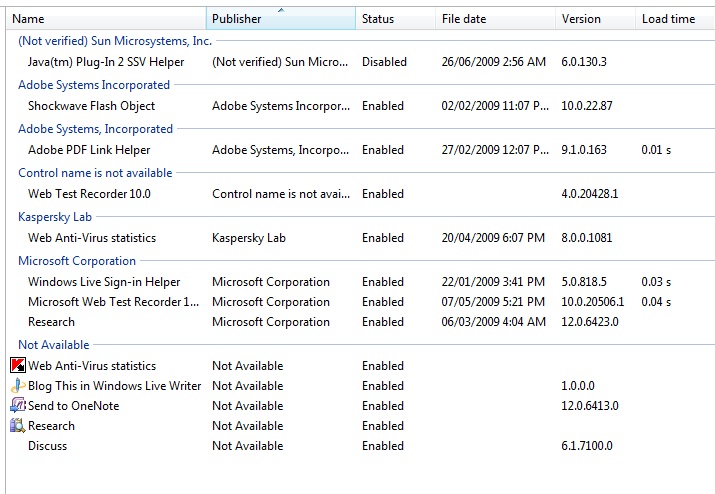
As it turns out, as soon as I enabled the first one on the list (Java plugin helper), the slowness returned. Just for good measure, I went through and enabled each of the other add-ons individually, and none of the them caused any performance change.
So, now the Java plugin helper is disabled, all the others enabled, and all is good. When I get around to it, I will look and see if there is a fix for this plugin.
Makes me wonder, though, how something as fundamental as the Java plugin could be causing this problem, with no one screaming about it. Is it just me?
Have a look at this…
Consumerist – Applying For A Job? Great, Give Us Your Google And Facebook Passwords – Facebook
This redneck town thinks it is ok to invade a person’s privacy if they want a job. By this same logic, it would be ok to tap the person’s phone, open their mail, peek through their windows…
While I can understand the need to perform background checks, this is completely inappropriate.


 FredSpace
You must be logged in to post a comment.